Two 12-Inch Pizzas vs. One 16-Inch Pizza: The Math Explained
Which is bigger: two 12-inch pizzas or one 16-inch pizza? See the exact geometric math (Area = πr²), total surface area comparison, crust ratio, and best deal.
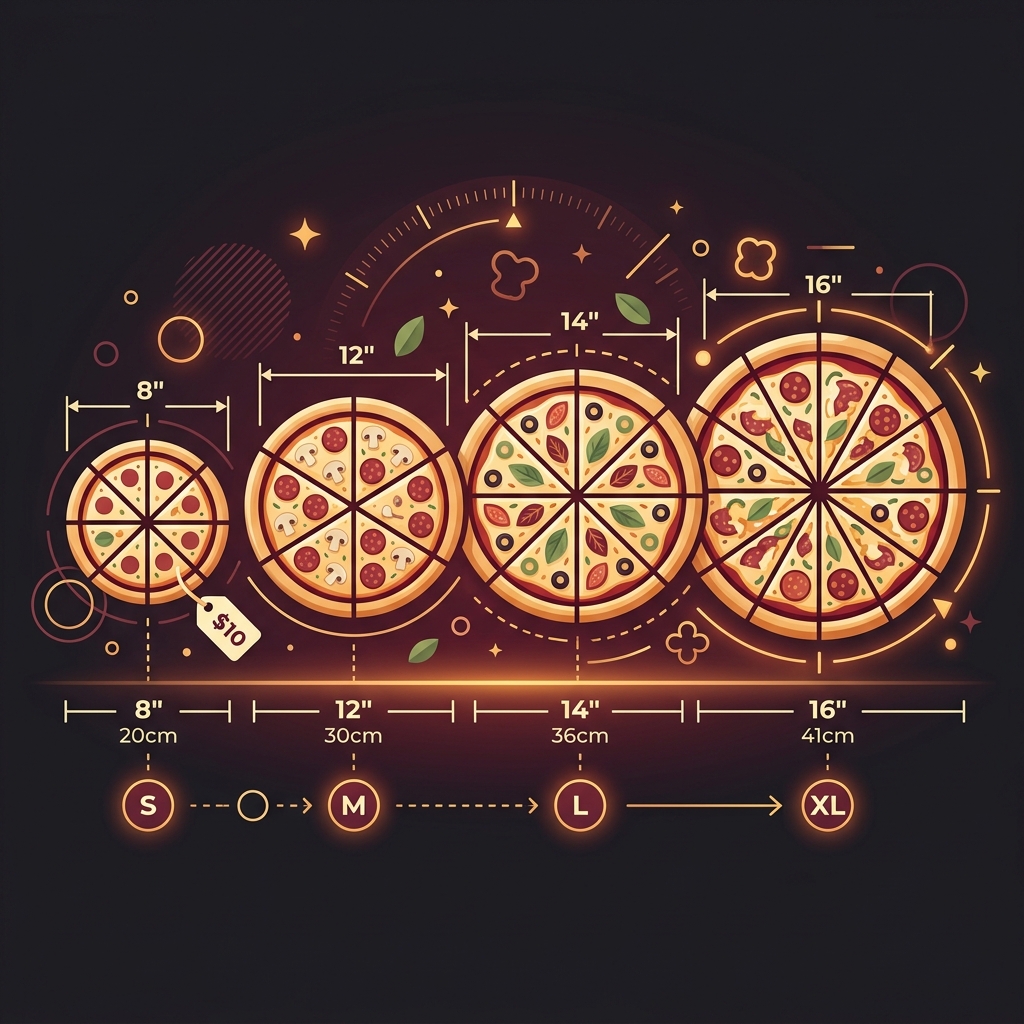
Two 12-Inch Pizzas vs. One 16-Inch Pizza: The Math Revealed
It is one of the most famous viral math debates on the internet: Do two 12-inch medium pizzas give you more food than one 16-inch extra-large pizza?
At first glance, intuition misleads most diners. Twelve plus twelve equals twenty-four, and twenty-four is significantly larger than sixteen. However, pizzas are circular disks, and circular food is governed by two-dimensional surface area, not linear diameter.
Here is the exact geometric proof, the crust-to-topping ratio comparison, and how to decide which option gives you the best financial value.
The Geometric Proof: Area = π × r²
To calculate the food you actually eat, we compute the area using radius $r$ (half the diameter):
1. The 16-Inch Extra-Large Pizza
- Diameter: 16 inches
- Radius ($r$): 8 inches
- Formula: $\text{Area} = \pi \times r^2 = \pi \times 8^2 = 64\pi$
- Total Surface Area: ~201.1 square inches
2. Two 12-Inch Medium Pizzas
- Diameter: 12 inches each
- Radius ($r$): 6 inches
- Area of One 12″ Pizza: $\pi \times 6^2 = 36\pi \approx 113.1\text{ sq inches}$
- Area of Two 12″ Pizzas: $2 \times 36\pi = 72\pi$
- Total Surface Area: ~226.2 square inches
The Verdict on Total Food:
Two 12-inch pizzas deliver 25.1 square inches (12.5%) more pizza than one 16-inch pizza.
The Hidden Catch: The Crust Handle Factor
While two 12-inch pizzas win on raw square inches, they carry a hidden physical penalty: crust circumference.
Using the circumference formula ($C = 2\pi r = \pi d$):
- One 16-inch pizza crust rim: $16\pi \approx \mathbf{50.3\text{ linear inches}}$ of handle edge.
- Two 12-inch pizza crust rims: $2 \times (12\pi) = 24\pi \approx \mathbf{75.4\text{ linear inches}}$ of handle edge.
Two 12-inch pizzas have 50% more outer handle crust than a single 16-inch pizza.
If your friends or family leave the dry crust handles behind on their plates, the single 16-inch pizza actually delivers more cheese, sauce, and center topping area per bite. But if your group loves crispy crust and garlic dipping sauce, the two mediums provide substantially more food.
Summary Comparison Table
| Metric | Two 12-Inch Pizzas | One 16-Inch Pizza | Difference |
|---|---|---|---|
| Total Surface Area | 226.2 sq in | 201.1 sq in | +25.1 sq in (+12.5% more food) |
| Crust Edge Circumference | 75.4 inches | 50.3 inches | +25.1 inches (+50% more crust) |
| Topping Flexibility | 2 Different Flavors | 1 (or half-and-half) | Two mediums allow flavor variety |
| Standard Slices | 16 slices (8 each) | 12 slices | 4 extra individual slices |
Want to test your local pizzeria’s prices? Plug them directly into our Pizza Size Calculator or check restaurant deals on our Pizza Price Comparison Tool.
This reference guide was formulated using Euclidean circle geometry ($A = \pi r^2$) and official menu specifications. Learn more about our calculation methodology on our About Page and our data verification standards in our Editorial Policy.
Notice a dimension change or pricing update at your local store? Report a correction.
Want to compare these sizes live?
Use our free Pizza Size Calculator to compute area, price per square inch, and find out which pizza is the best deal.
Open Calculator 🍕